
DETAILS
Get up-close and personal
to a variety of species and
learn how the animals’ health
and well-being are cared for
A full day of 5.7 scientific CE credits,
including courses that align with
a variety of interests and professional
development needs
See all the attractions across the
190-acre site, home to over 2,400
animals and 340 species with a focus
on education and conservation
Make valuable connections
with peers from various clinics
and backgrounds, expand your
knowledge and have a blast
SCHEDULE
7:30 a.m. Registration & Breakfast
9 a.m. Animal Experiences
9:30 a.m. Zoo Opens to Public
10 a.m. Large, Small & Equine CE Lectures
11:15 a.m. Large, Small, & Equine CE Lectures
12:15 p.m. Lunch
12:45 p.m. Ambassador Animals
1:30 p.m. Large, Small, & Equine CE Lectures
3 p.m. Animal Experiences
4 p.m. Q&A with Dr. Christy
5:15 p.m. Event Ends
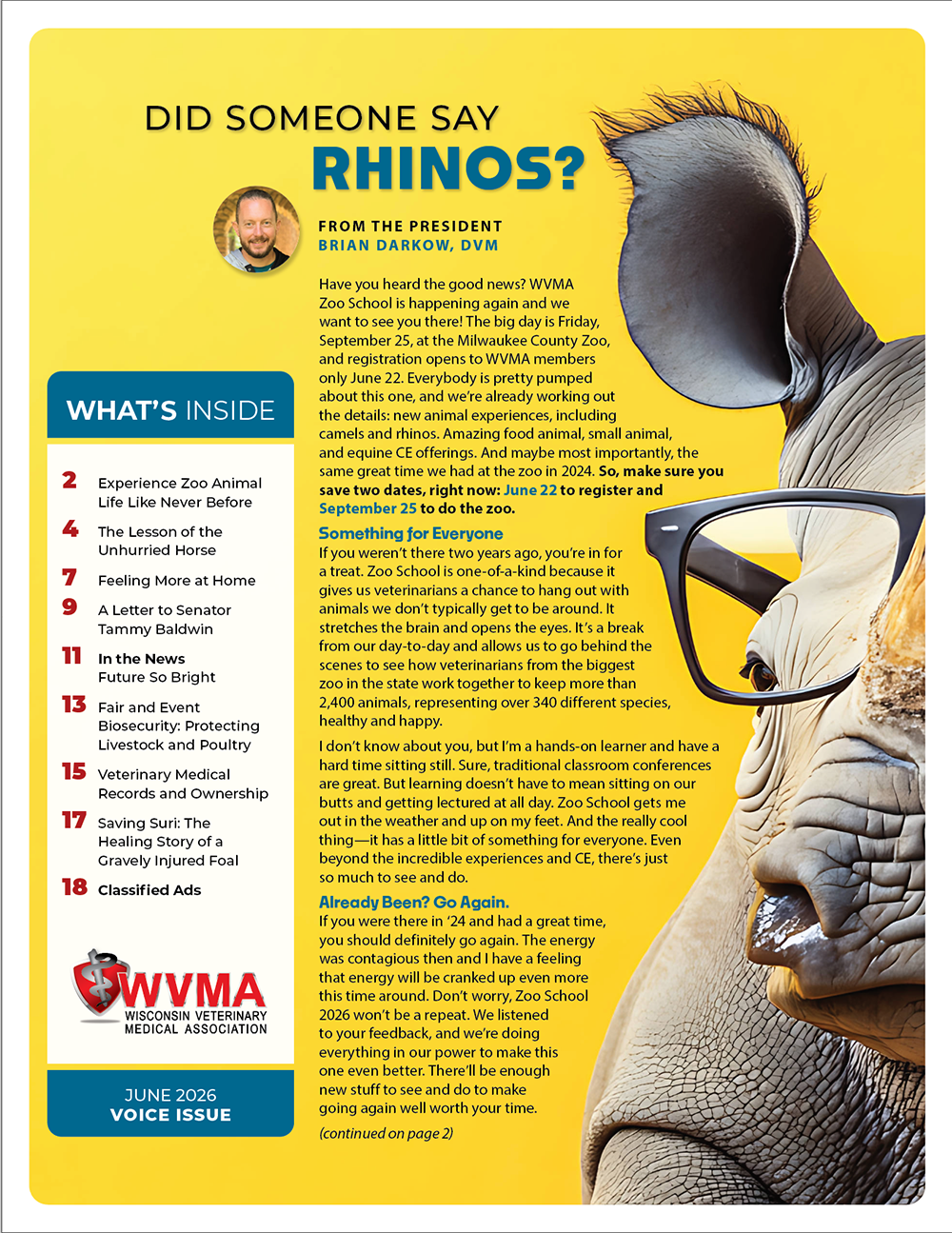
For more details, read your June Voice cover story, and find out why WVMA President Dr. Brian Darkow thinks Zoo School is so cool.
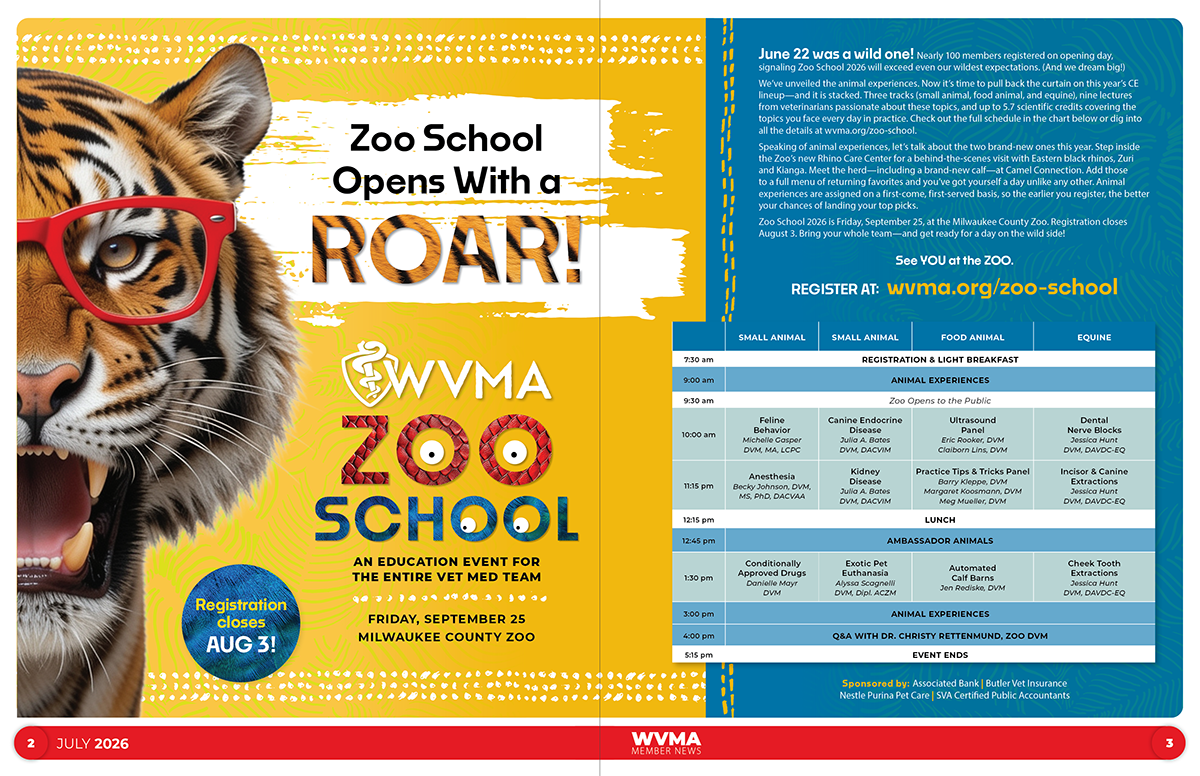
Read the July Voice Zoo School spread.
COURSE SCHEDULE
Small Animal
10 a.m. – 11 a.m.
101: Feline Behavior
101: From Hiss To Bliss: Practical Psychopharmacology for Feline Behavior Cases
1-hour Lecture • 1.2 scientific credits
Feline behavior cases are frequently seen by veterinary clinicians. Oftentimes, these patients are presented by clients who have tolerated these situations for months, even years. Clients often feel hopeless and, in some cases, believe that euthanasia is the only reasonable choice. In this lecture, we will present the most common feline behavior cases and review psychopharmacological interventions and environmental recommendations to help these patients.
Michele Gaspar, DVM, MA, LCPC, is a 1994 graduate of the University of Wisconsin-Madison School of Veterinary Medicine and has worked in emergency/critical care, small animal, and feline-exclusive practice as a board-certified feline specialist. Michele is currently a consultant in the Feline Internal Medicine Folder of the Veterinary Information Network (VIN) and a human psychotherapist in private practice. Michele and her husband, David, live in Chicago with two cats, a Shih Tzu, and an engaging tank of freshwater fish.
102: Canine Endocrine Disease
102: Monitoring Canine Cushing’s Disease: What Actually Matters?
1-hour Lecture • 1.2 scientific credits
Monitoring canine Cushing’s disease can be frustrating, and conflicting recommendations have left many clinicians wondering which approach is best. This practical lecture reviews the evidence behind current monitoring strategies, highlights what actually matters when making treatment decisions, and provides clear, practical recommendations you can use in practice the very next day.
Julia Bates, DVM, DACVIM (SAIM), FFCP, is an internal medicine specialist with strong interests in cardiopulmonary, immune mediated and endocrine diseases. Her clinical research interest is in hypoadrenocorticism (Addison’s disease). Dr. Bates, along with other industry colleagues, recently had a retrospective study, “Lower Initial Dose Desoxycorticosterone Pivalate for Treatment of Canine Primary Hypoadrenocorticism,” accepted for publication in the Australian Veterinary Journal. In 2020, Dr. Bates joined MOVES and serves veterinary hospitals in the Madison and Milwaukee metro areas.
11:15 a.m. – 12:15 p.m.
201: Anesthesia
201: From Pugs to Persians to Pinschers: Custom Anesthesia for Different Breeds
1-hour Lecture • 1.2 scientific credits
This interactive lecture will review current approaches to tailoring anesthetic and analgesic protocols for companion animal breeds with unique physiological considerations, including brachycephalic breeds. Topics will include the genetic basis of anesthetic and analgesic management, how physiological differences influence patient care, and strategies for modifying anesthetic plans accordingly. Practical discussion will cover drug selection, monitoring techniques for detecting physiological changes, and the incorporation of novel and validated pain-scoring systems. Participants will gain a deeper understanding of current anesthetic and analgesic practices for these patients and how to adapt protocols to support optimal outcomes. This session is designed for veterinary assistants, veterinary technicians, and veterinarians involved in the sedation, monitoring, and anesthesia of companion animal patients.
Becky Johnson, DVM, MS, PhD, DACVAA, earned her Doctor of Veterinary Medicine degree from The Ohio State University in 1993 and subsequently completed a residency in Veterinary Anesthesiology and Pain Management and a Master of Science degree at the University of Wisconsin–Madison, becoming board-certified in 1997. She completed a PhD in Respiratory Neurophysiology in 2002 and currently serves as a Clinical Professor of Anesthesia and Pain Management and Research Anesthesiologist at the University of Wisconsin–Madison School of Veterinary Medicine. Her professional interests include advances in anesthetic and analgesic techniques for laboratory animal species and the effects of opioid and non-opioid analgesics on the gastrointestinal and respiratory systems of companion animals.
202: Kidney Disease
202: Managing Chronic Kidney Disease: What Actually Improves Outcomes?
1-hour Lecture • 1.2 scientific credits
Managing chronic kidney disease has become increasingly complex, with new medications, diets, nutraceuticals, and treatment recommendations emerging every year. This practical, evidence-based lecture reviews the therapies that truly improve patient outcomes, helps clinicians prioritize treatment recommendations, and provides straightforward strategies that can be applied immediately in general practice.
Julia Bates, DVM, DACVIM (SAIM), FFCP, is an internal medicine specialist with strong interests in cardiopulmonary, immune mediated and endocrine diseases. Her clinical research interest is in hypoadrenocorticism (Addison’s disease). Dr. Bates, along with other industry colleagues, recently had a retrospective study, “Lower Initial Dose Desoxycorticosterone Pivalate for Treatment of Canine Primary Hypoadrenocorticism,” accepted for publication in the Australian Veterinary Journal. In 2020, Dr. Bates joined MOVES and serves veterinary hospitals in the Madison and Milwaukee metro areas.
1:30 – 2:30 p.m.
301: Conditionally Approved Drugs
301: Approved…Sort Of? Understanding Conditionally Approved Drugs in Small Animal Medicine
1-hour Lecture • 1.2 scientific credits
This lecture will provide a practical refresher on conditionally approved drugs, including what conditional approval means, how these products can be used in clinical practice, and the currently available options for small animal practitioners. Attendees will gain a better understanding of the role of conditionally approved medications and how they can be incorporated into patient care.
Danielle Mayr, DVM, earned her Doctor of Veterinary Medicine degree from the University of Wisconsin School of Veterinary Medicine and practiced small animal general medicine in Wisconsin for six years before beginning a PhD in Physiology and a residency in Veterinary Clinical Pharmacology at Kansas State University in 2026. Her research focuses on pain models and the pharmacokinetics and pharmacodynamics of nonsteroidal anti-inflammatory drugs (NSAIDs) in small ruminants and calves.
302: Exotic Pet Euthanasia
302: Approaching Euthanasia in Exotic Pets
1-hour Lecture • 1.2 scientific credits
Euthanasia in exotic companion animals can be one of the most challenging aspects of clinical practice, leaving many veterinarians uncertain about appropriate sedation protocols, euthanasia techniques, and species-specific considerations. This session will review current AVMA euthanasia guidelines for small mammals, birds, reptiles, and fish while providing practical tips and techniques that can be immediately applied in general practice. Recent evidence-based advances in euthanasia methods will also be discussed, highlighting approaches that may improve patient welfare, reduce stress, and simplify procedures for both veterinarians and owners. Whether you see exotic pets regularly or only occasionally, this lecture will provide the knowledge and confidence needed to approach end-of-life care in these unique species.
Alyssa Scagnelli, DVM, Dipl. ACZM, earned her Doctor of Veterinary Medicine degree from the University of Missouri College of Veterinary Medicine in 2015 and completed companion animal and zoological internships at Louisiana State University School of Veterinary Medicine, where she developed a strong foundation in exotic and wildlife medicine. From 2017 to 2024, she practiced as an associate veterinarian at the Avian and Exotic Animal Clinic in Mesa, Arizona, while also serving as adjunct faculty at Midwestern University College of Veterinary Medicine, contributing to clinical research, instruction, and student mentorship. In 2024, Dr. Scagnelli became a Diplomate of the American College of Zoological Medicine with a subspecialty in zoological companion animals. She is currently a faculty member at the University of Wisconsin–Madison School of Veterinary Medicine, where her interests include teaching, clinical research, and advancing the care of exotic species, particularly reptiles and aquatic animals. Outside of veterinary medicine, she enjoys rock climbing, hiking, kayaking, gardening, traveling, and SCUBA diving with her husband and shares her home with a variety of fish, reptiles, invertebrates, birds, and dogs.
Food Animal
10 a.m. – 11 a.m.
103: Ultrasound Panel
103: Growing Ultrasound Services in Clinical Practice
1-hour Lecture • 1.2 scientific credits
As veterinary medicine continues to evolve, practices must adapt to meet changing client needs and advances in patient care. This panel discussion will explore how clinics have successfully expanded their ultrasound services, including the types of clients they serve, strategies for growth, and lessons learned along the way. Panelists will share both successes and challenges, providing practical insights for practices looking to enhance their diagnostic capabilities.
Erick Rooker, DVM, has been a primary dairy practitioner for more than 13 years and a practice owner for eight years. Throughout his career, he has contributed to the development of innovative medical services, herd-level consulting programs, and practice protocols that often exceed industry standards. His expertise in veterinary technology, inventory management, and knowledge brokering has led to numerous speaking engagements at both state and national levels, where he shares insights on advancing efficiency and innovation in veterinary practice.
Claiborn Lins, DVM, earned her Doctor of Veterinary Medicine degree from the University of Wisconsin School of Veterinary Medicine in 2023 after completing her undergraduate studies in Dairy Science at the University of Wisconsin–River Falls. She currently practices livestock medicine with Lodi Veterinary Care and is interested in all aspects of food animal production. A proud Wisconsin native who grew up in Waupun, she appreciates the state’s agricultural heritage and enjoys spending time with her family, friends, husband, and young son.
Kendra Wells, DVM, grew up in Northwestern Wisconsin, where she skipped summer camp and helped with chores on her Aunt and Uncle’s dairy farm. As a college student, she worked for a handful of dairies across the state, which inspired her to pursue dairy medicine and work with people who love cows, too. This brought her to Valley Veterinary Clinic in Seymour, where she is currently an owner in the business. Her specialty interests include youngstock and employee improvement. Outside of work, she enjoys fishing with her family, crafting, and visiting family and friends.
11:15 a.m. – 12:15 p.m.
203: Practice Tips & Tricks Panel
203: Lessons Learned Beyond Veterinary School: A Food Animal Panel Discussion
1-hour Lecture • 1.2 scientific credits
One of the greatest resources available to veterinarians is the collective knowledge and experience of their colleagues. This interactive panel discussion will explore practical lessons, tips, and techniques that are often learned through experience rather than formal training. Panelists will share challenges they encountered in practice, important lessons learned, and strategies for developing confidence when faced with unfamiliar situations. In addition to discussing their favorite approaches to food animal medicine, panelists will encourage audience participation and the sharing of experiences from the field.
Barry Kleppe, DVM, grew up on family dairy farms in Verona and Hollandale, Wisconsin, and earned a Bachelor of Science, Master of Science, and Doctor of Veterinary Medicine degree from the University of Wisconsin. He joined Waunakee Veterinary Services in 1991 with a passion for dairy practice and has dedicated more than three decades to serving dairy producers and supporting Wisconsin’s dairy industry. Outside of work, he enjoys spending time with his family, golfing, fishing, and relaxing with a traditional Wisconsin Old Fashioned.
Margaret Koosmann, DVM, was born and raised in Mellen, Wisconsin, on her family’s fifth-generation farm. She earned her undergraduate degree from Northland College in 2010 and her Doctor of Veterinary Medicine degree from the University of Wisconsin School of Veterinary Medicine in 2015 before joining Ashland Area Veterinary Clinic, where she now serves as owner. Dr. Margaret enjoys working with both small and large animals and values the relationships she builds with their caregivers. She is grateful for the opportunity to serve the community that has supported her throughout her life and enjoys participating in activities on her family farm, cooking, and playing slow-pitch softball.
Meg Mueller, DVM, earned her Doctor of Veterinary Medicine degree from the University of Wisconsin–Madison School of Veterinary Medicine in 2010 and practices mixed animal medicine at Osseo-Augusta Veterinary Clinic, where she became a partner and owner in 2021. She is actively involved in organized veterinary medicine and is a past president of the WVMA. Her professional interests include veterinary leadership, advocacy, mental health and well-being within the profession, and supporting the future of veterinary medicine through strong professional networks. Committed to giving back to the agricultural community that shaped her upbringing, she volunteers with local youth livestock programs and county fair activities and works with the Wisconsin Horse Pullers Association during the summer.
1:30 – 2:30 p.m.
303: Automated Calf Barns
303: Managing Health and Performance in Automated Calf Barns
1-hour Lecture • 1.2 scientific credits
As automated calf barns become increasingly common, veterinarians must be prepared to address the unique management and health challenges these systems present. This lecture will provide a firsthand perspective on working with automated calf-rearing facilities, highlighting common pitfalls, management considerations, and practical recommendations for maintaining calf health and performance. Attendees will gain valuable insights into what to watch for and how to avoid common problems in these operations.
Jen Rediske, DVM, earned her Doctor of Veterinary Medicine degree from Iowa State University College of Veterinary Medicine in 2003 and joined Veterinary Associates that same year. She has been an owner of the practice for the past 20 years and has professional interests in calf health, herd management, and embryo transfer work. Outside of practice, she enjoys working alongside her husband and children on their beef farm, participating in endurance events such as Tough Mudder races, and serving on numerous community committees.
Equine
10 a.m. – 11 a.m.
104: Dental Nerve Blocks
104: Review of Regional Anesthesia Techniques for Equine Dental Extractions
1-hour Lecture • 1.2 scientific credits
This lecture will review anatomical landmarks and techniques for commonly used regional nerve blocks utilized for desensitization of equine dentition. In addition, we will review a recently published technique utilizing a periodontal ligament injection syringe that can be used as an alternative or adjunctive technique to traditional nerve blocks. This new technique is highly accessible to all levels of practitioners and can be incredibly useful for everything from wolf tooth extractions and deciduous teeth to permanent cheek teeth. Case selection factors will be discussed for treatment planning guidance.
Jessica Hunt, DVM, DAVDC-EQ, grew up in the East Troy, Wisconsin, area and earned her Doctor of Veterinary Medicine degree from the University of Minnesota College of Veterinary Medicine in 2018. Following graduation, she completed an equine internship at Southwest Equine Hospital in Scottsdale, Arizona, and joined the Midwest Veterinary Dental Services team in 2019. In 2023, she became a Diplomate of the American Veterinary Dental College’s Equine specialty, and her professional interests focus on equine dentistry and advancing oral health care for horses.
11:15 a.m. – 12:15 p.m.
204: Incisor and Canine Extractions
204: Simple Cheek Tooth Extraction Techniques in the Equine Patient
1-hour Lecture • 1.2 scientific credits
This lecture will review basic extraction instrumentation and outline a simple extraction technique for straightforward extractions (older horses, periodontal cases, etc.). High-quality intraoral videos will be utilized to demonstrate basic extraction techniques in a step-by-step fashion. Treatment planning will be discussed with emphasis placed on identification of complicating factors that may add layers of difficulty to the extraction.
Jessica Hunt, DVM, DAVDC-EQ, grew up in the East Troy, Wisconsin, area and earned her Doctor of Veterinary Medicine degree from the University of Minnesota College of Veterinary Medicine in 2018. Following graduation, she completed an equine internship at Southwest Equine Hospital in Scottsdale, Arizona, and joined the Midwest Veterinary Dental Services team in 2019. In 2023, she became a Diplomate of the American Veterinary Dental College’s Equine specialty, and her professional interests focus on equine dentistry and advancing oral health care for horses.
1:30 – 2:30 p.m.
304: Cheek Tooth Extractions
304: Incisor and Canine Tooth Extraction Techniques in the Equine Patient
1-hour Lecture • 1.2 scientific credits
This lecture will review common incisor pathology encountered in our equine patients. A step-by-step description of the extraction technique utilized for incisor and canine teeth will be illustrated through pictures and demonstration videos. Interesting cases will be presented at the end of the lecture.
Jessica Hunt, DVM, DAVDC-EQ, grew up in the East Troy, Wisconsin, area and earned her Doctor of Veterinary Medicine degree from the University of Minnesota College of Veterinary Medicine in 2018. Following graduation, she completed an equine internship at Southwest Equine Hospital in Scottsdale, Arizona, and joined the Midwest Veterinary Dental Services team in 2019. In 2023, she became a Diplomate of the American Veterinary Dental College’s Equine specialty, and her professional interests focus on equine dentistry and advancing oral health care for horses.
ANIMAL EXPERIENCES
Small Animal, Food Animal, and Equine CE tracks are bookended by two of these animal experiences.

Witness the impressive outdoor routine of African elephants as they engage in staff-led activities that maintain their health and well-being. Learn about the daily care routines and husbandry practices of these majestically massive creatures, as well as their social dynamics and natural behaviors. The training wall allows an up-close experience from the safety of a covered pavilion.

Observe the graceful movements of the tallest land animals in the world from the indoor enclosure. Listen as the zookeeper provides a deeper understanding of the everyday lives, adaptations, husbandry practices, and daily care routines of these gentle giants.

Learn about the fascinating worlds of Gentoo and Rockhopper Penguins. These flightless beauties native to South America’s coastal regions exhibit playful antics and endearing personalities. Hear how their black and white plumage serves as camouflage from predators while hunting fish and squid, and how their wings serve as flippers to propel their streamlined bodies forward in the water.

Tending to the physical health and overall well-being of every animal in the zoo is a demanding but rewarding job for the Animal Health Center staff. With a focus on preventive medicine, this team cares for a collection of unique animals, each with individual health needs. This is your chance to get a private tour and in-depth look at the quarantine and treatment spaces where this specialized care is provided.

Get an inside look at a feeding and training session for lions or hyenas. Zoo staff share details about the power of these powerful predators. Hear the vital role of training and how it complements natural instincts when providing daily care. View enrichment activities that give the big cats the space and freedom to do what comes naturally.

Caring for marine mammals presents a whole new set of challenges than those of the zoo’s land-dwelling cohorts. The animal care staff will share interesting facts about the harbor seals, including behaviors, diet, and care routines, during a training session that offers a unique glimpse into the daily lives of these intelligent creatures.

View the underwater world of the Amazon Basin from above the indoor environment tank. The zookeeper will discuss the intricacies of this rich ecosystem, sharing insights into the lives and husbandry practices of the various species. During a fish feed, learn about the behaviors, dietary preferences, and conservation efforts aimed to preserve biodiversity.

Swing into the world of these fascinating primates in a naturalized outdoor habitat while hearing about their intricate matriarchal social structures, unique behaviors, adaptability, and intelligence. Learn the importance of conservation efforts in place to protect the many endangered macaque species. And meet the staff on the overlook deck to observe a macaque enrichment opportunity.

Go behind the scenes of an immersive tank exhibit replicating the vibrant underwater world of Wisconsin’s lakes. Amidst the gently swaying aquatic vegetation and rocky outcrops is a diverse array of fish species. Learn about the importance of preserving these delicate habitats and the role each species plays in maintaining the health of Wisconsin waters.

BRAND NEW! Step inside the Zoo’s new Rhino Care Center for a behind-the-scenes look at the care and management of Eastern black rhinos Zuri and Kianga. From training and daily husbandry to conservation and veterinary support, discover how zoo professionals work together to help this critically endangered species thrive.

BRAND NEW! Long eyelashes, two humps, and a personality all their own. Meet the herd, learn about their care and conservation, and hear behind-the-scenes insights from the animal care team—including updates on the Zoo’s newest camel calf and life in a growing camel family.

Inca terns, seabirds native to the Pacific coast of South America, are known for their striking appearance, with black and white plumage, red bills, and distinctive white mustaches. They primarily feed on small fish skillfully caught by diving from the air. Assist with supplying food to the Inca terns during this private session in the indoor aviary.

Visit the serene surroundings of the outdoor flamingo habitat as the knowledgeable staff shares engaging commentary on the lives and care of these beautiful residents. Hear about their social behavior, diet, and healthcare needs, and gain a deeper understanding of these captivating creatures and their importance to the ecosystem.
LOCATION
Questions? Call 608-257-3665 or email wvma@wvma.org.
Milwaukee County Zoo, Milwaukee, WI
Dates: Friday, September 25
Address: 10001 W. Bluemound Road, Milwaukee, WI 53226
Parking and Entry: Zoo School attendees can park in Lot #2 and will arrive before the zoo officially opens. Please let the person at the gate know you are there for the WVMA event. Once parked, enter at the front doors and register at the WVMA table in the lobby.
Thank you to our Event Partner


MEALS
Light breakfast at 7:30 a.m.
Pastries, fruit, and coffee are available in the Peck Center after you register for the day’s activities.
Lunch at 12:15 p.m.
Enjoy a tasty taco bar in the Peck Center. You’ll have enough time to meet the zoo’s friendly ambassador animals and their handlers before heading off to your next CE lecture.
Snacks
Coffee and zoo snacks will be available all day to keep you fueled through your lectures, wildlife encounters, and peer connections.
SPONSORS